The History of one Illusion


Living in a typical multi-story building on the edge of the city, and periodically admiring the elegiac view from the window of my room - showing the blue forest at a distance beyond the fields behind the row of garage facilities - it never came to my mind what a poetic story of bankruptcy can be told by looking at my house, and at the neighboring twin house, and at this field, and at the forest, and at the garages and at everything I see practically every day, while hurrying to the bus stop or to the nearest supermarket. It's not surprising it never occurred to me - fairy-tale characters do not know that they live in a fairy-tale. They just live in accordance to the plot and in ways predetermined - a life for the edification of others.

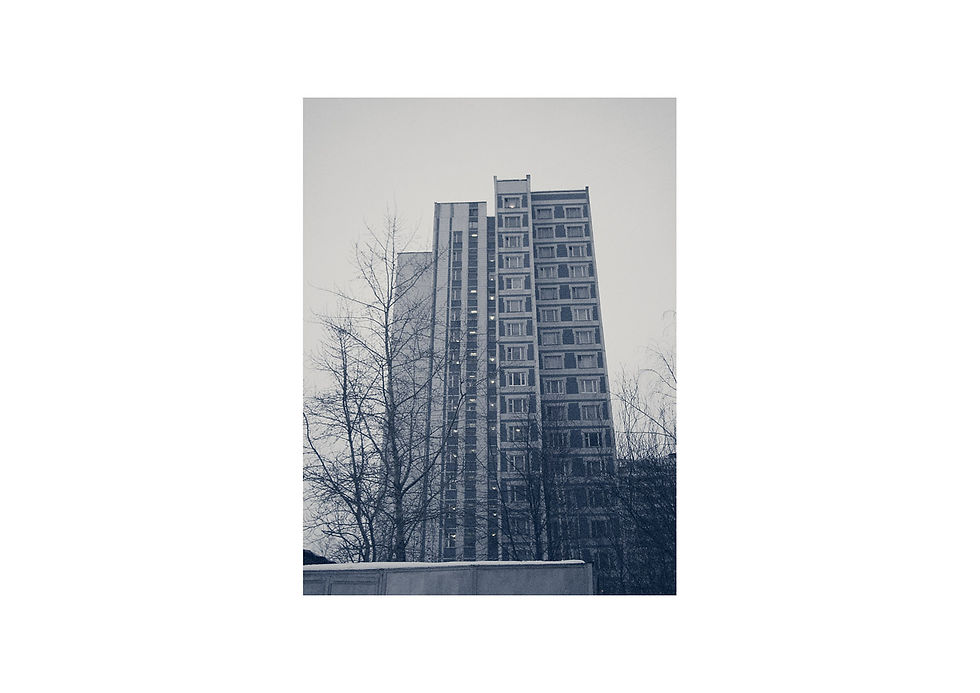
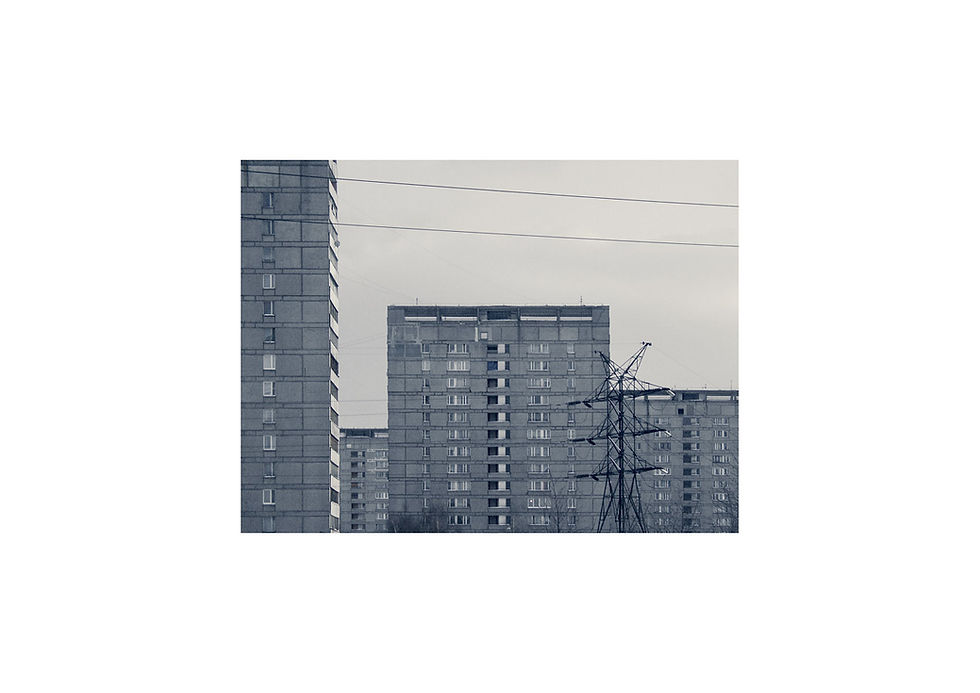
Generally, these typified buildings and the monotony of our microraions with their could-be-better infrastructure, pernicious influence on health, pluses and minuses, all of this and many other things, have already been talked and written about many times. But what is good about art is that one picture can replace a thousand words. The photographic project "Megastructure" by the Dutch artist Bee Flowers, not only reflects upon this, but also on the impactful failure of the great anthropological Utopia concerning the equality of all people, or at least of all people in one distinct country. This utopian idea is incorporated into architecture, and is thus corporally realized in ferroconcrete blocks of faceless multistory buildings. Megastructure deals with an illusion which was destroyed by human reality, and with the people who have to live among the remnants of this illusion.

The artist's detached rational outlook on the world of the 'sleeping districts' within the megapolis becomes the expression of a whole world of ideas. The work is not tied to a specific locality, and does not resemble the notes of a traveler attracted by the exotics and the otherness of an alien country. And though such approach could have been the starting point for the project, at some point the topography of a specific place becomes part of the conversation in general, and evolves into a discussion or meditation on mankind's global problems. And the past, lingering in the present of a single country - of one city, of one microraion - is suddenly projected into a possible future.

Perhaps the first thing to catch our attention is the collision of the natural world with the human world - civilization. This happens at that level of consciousness where man correlates his actions with his aspiration for happiness. But man's happiness is not part of nature's functionings, and from this conflict of interests sounds a theme of assimilation, of hostile take-over; the conquest of nature, its submission and, seen in perspective, its destruction. This will be the consequence of man for himself - a lifeless desert filled with archeological trash of iron, glass and concrete. And indeed some pictures show something similar in feeling to such dead, ghost-populated cities.

However, let's go back to the Utopia of equal and equalizing justice. The equality of all people is taught by religion and the communists and democrats alike. But the most indisputable convictions can be the most dubious. Why could these views not just limit themselves to the realm of ideas? (which is in fact what religion does when shifting its focus to a space and time after life.) Problems arise when ideas try to subdue human reality, to restrain it within the framework of a rigid theoretical scheme, while winnowing out all that will not fit. And what a sharp border it is indeed that outlines the city space in Megastructure. Rising like sentries, the high rise buildings seem to stand watch to ward off external "enemies" - not so much guarding the space inside the microraion, or the city, but the scheme itself, the idea that gave rise to it.

Reality, ever revolting and trying to break free, tests the imposed scheme for strength, and at some time sooner or later, that scheme will fail. A frame imposed too rigidly will always be destroyed, while ambiguous and adjustible systems are potentially more vital. Herein, by the way, lies a principal difference between Christianity and Communism. Communism collapsed like a house of cards. The idea of general equality, of peace with no envy, went bankrupt. And this happened not through pressure of outside forces, but from within. The Soviet phenomenon, manifested through the power of state-corporal embodiment, that is to say actual socialism, turned out different from its imagined variant. The resulting reality was in fact the opposite of the anticipated: instead of collective creation, we saw pathetic-emotional confluence; total loneliness, alienation, isolation in one's own cell. A joyless and pedestrian existence.

In retrospect, the construction of socialism within the idea of communism seems as some collective artistic action. An ideological-aesthetic experience whereby viewer and actor (or manufacturer and user) were in essence the same person. The dissolution of personality in a pre-individual community.

It's interesting here to compare the fine arts to the architecture of the Soviet period. Stylistically, ideal socialist realism leans on Academism, and later on the Peredvizhniki movement, while the architecture of the Soviet State was stylistically oriented towards Modernism. And architecture in this sense was essential to and reflective of the processes of rapid modernization taking place within the country. Therefore, it was architecture, and not the fine arts with its humanistic inclinations and human nature, that was the true manifestation of the State's ideas. Similar processes occurred in the West, too, but were met with much stronger resistance, due to the deeper roots of individualism, while Russia, with its inclination towards community, adherence to national roots (autocracy - Christianity - folk culture) turned out to be more susceptible to the processes of modernization, collectivity, and communal life (with all the world). Therefore, for example in France, mass construction of typified housing is not popular, and today only the poor live in housing blocks, and the microraions are high crime areas. Here in Russia, construction continues along these very lines, although now with attempts to introduce variations through superficial cosmetic modifications.

However, there are links leading from this architecture to the Soviet fine arts as well: late-period Peredvizhniki and Academism is marked by a minimalism of the picturesque and of formal properties. This minimalism, or universalism, is the point of intersection of architecture and the fine arts. In both areas, formal refinements were not popular. This also points to another widespread theme of socialist realism - the birth of a collective personality. However, when pure socialist realism was abandoned around the mid 1950-s and the fine arts came to concentrate on the individual, it was architecture, as part of the ideologically sharply aware mass culture, which took the lead baton.

In Bee Flowers' photographs, this confrontation of the individual and the collective is shown through the contrast of the individuality and singularity of a blade of grass or a color-accentuated detail vs. the oppressive monotony of the architecture. Their facelessness is their depersonalizing aggression. The artist reverses the hierarchical order of things, giving monumental meaning to the smallest parts - that which is considered secondary now becomes the principal. Still, the fragments of the Soviet discourse continue to function. Whether the Great Construction perpetuates due to inertia or by deliberation is another question. In the world of ruined and bankrupted illusions, life goes on. Life within the decorations of a staged play.

Megastructure employs a complex space-time solution. The project is divided into five parts. Early in the morning, we approach the city, walk there for a day, and then leave in the evening. On one side it seems a one-day excursion starting at the dawn and ending with a sunset. And on the other side it seems like traveling in historical time. A city emerging from the sunset and then disappearing back into the twilight. The history of one illusion.

Bee Flowers plays with stereotypes and images of mass consciousness. In this case, it's Winter. Russia, in the imagination of the rest of the world, is first and foremost associated with Winter. But in the context of the aforesaid, it might alse appear like a reminder of the Cold War. And like a fading of forward striving, futuristic energy. But Winter is a dream, and not death. The remaining construction sites may be filled once again with workers and their superintendents. Therefore, Winter itself may be interpreted as a prelude to the birth of something new. Only what will this novelty be like?

Also, the Soviet Utopia turns out to be very topical in the situation of today's globalized utopia. Globalism - and virtuality - reach towards the future. It is interesting that when the whole world is now infected with these ideas, Russia seems asleep. It has already lived through all of that. Interestingly, in the telling of this sad story about the failure of the communist utopia, Flowers applies almost no special effects. No distortions, no sudden foresights, just an unbiased view of a man walking down the street. Everything is left as it is. Only the technique, by impression reminiscent of grisaille, a favorite of the 15th and 16th century artists throughout Europe, gives a feeling of something that has sunk into oblivion. Yet all this is without obsessiveness, preserving the graphical objectivity of black-and-white photography.

Hyperboles were unnecessary; holding up a mirror sufficed; the reflected image demonstrates the absurd. Thus, reality as it is, becomes the metaphor. The paradox being that a metaphor itself signifies an escape from reality, from speaking forthright and directly. The artist overcomes brutal realism. It's at once a drama of ideas and a "human drama."

Bee Flowers actualizes the problem of modernization and globalization, the difference between a concept and its realization, and he joins within the space of one project the small and the great, the idea and its reality, but does not offer a solution. He is speculating and… admiring. The rational detachment in the view cast on the landscape enables the artist to see the peculiar topographical beauty of Russia. A country of big spaces, big conflicts, big ideas and big delusions.

Lia Adashevskaya,
Art Journal DI

(Translated from Russian)